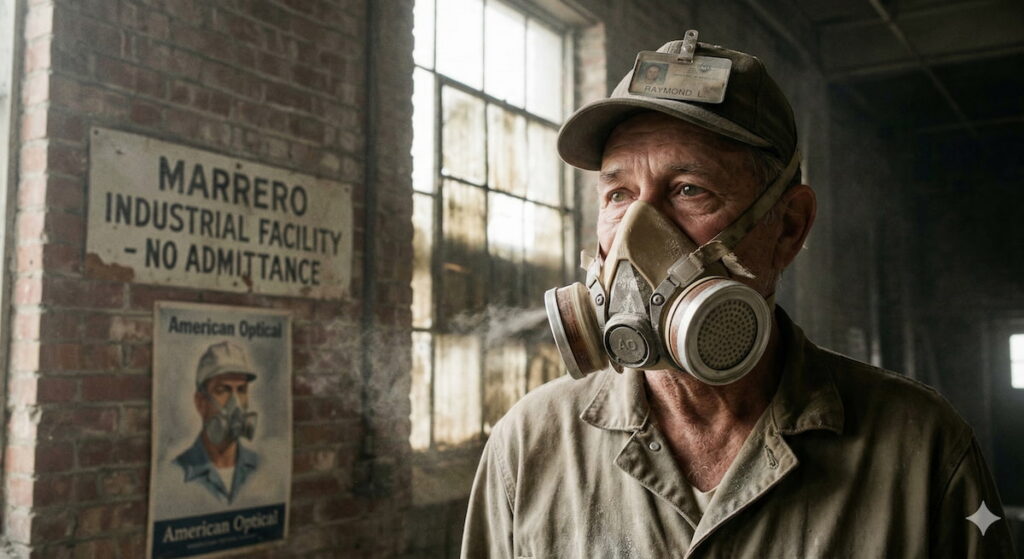
For decades, industrial workers in Marrero, Louisiana, relied on American Optical respirators to protect them from toxic asbestos dust. Tragically, many of these safety products were defective, leading to thousands of cases of asbestos-related lung cancer. If you or a loved one used these respirators between 1956 and 1970, you may have a claim—but a recent ruling in the Lemieux case serves as a massive warning: what you sign today could bar your family from seeking justice later.
If you worked in Marrero and were diagnosed with lung cancer or mesothelioma, visit our main Louisiana Asbestos & Mesothelioma Lawyer page to protect your rights before it’s too late.
The American Optical Case in Marrero
Raymond J. Lemieux Sr. (“Raymond Sr.”) worked in Marrero, Louisiana, from 1956 to 1970. During this time, he was exposed to asbestos and wore a respirator designed by American Optical. Because of this exposure, he developed asbestos-related lung cancer, culminating in his death in 2015.
Before he died, Raymond Sr. sued American Optical based on his use of their respirator. Raymond Sr. entered into a settlement agreement dated February 10, 2011, with American Optical. As part of the settlement, Raymond Sr.’s wife and children had to sign a release of any potential future claims they might have had against American Optical. They individually initialed each page of the settlement agreement and a notarized statement. The agreement stated that the parties had executed it of their own free will after discussing the terms with an attorney.
Approximately one year after Raymond Sr.’s death and over five years after executing the settlement agreement, his widow and surviving children (“Plaintiffs”) sued American Optical in the United States District Court for the Eastern District of Louisiana. They alleged that the respirator was defectively designed and manufactured and deceptively marketed. They argued that the settlement agreement was null and void under Louisiana law.
American Optical filed a motion to dismiss under Fed. R. Civ. P. 12(b)(6). American Optical argued that the settlement agreement barred the claims from Raymond Sr.’s widow and children. They argued that the Plaintiffs could not say that the settlement agreement was null and void because it had been over five years since it was executed.
The Danger of the ‘Five-Year Rule’ in Louisiana Settlements
The District Court agreed with American Optical and granted its motion to dismiss. The District Court held that Plaintiffs’ claim that the settlement agreement was null was prohibited by Louisiana’s requirement to bring such claims within five years. See La. C.C. art. 2032. Therefore, their claim was dismissed because the Plaintiffs had waited over five years to argue that the settlement agreement was null and void. The plaintiffs then appealed.
The United States Fifth Circuit Court of Appeal affirmed the District Court’s dismissal of the Plaintiffs’ claims against American Optical. The Court of Appeal held that a lawsuit seeking to nullify a contract must be brought within five years under Louisiana law. The Court of Appeal rejected the arguments that the Plaintiffs could not have discovered the claim within five years. The Court of Appeal found that with reasonable diligence, Plaintiffs could have recognized their misunderstanding of the settlement agreement or asked questions about the release in the five years post-signing of the agreement. Therefore, no exception would allow the Plaintiffs to circumvent Louisiana’s five-year limit on claiming the settlement agreement was null and void.
Never Sign a Release Without an Independent Review
Navigating lawsuits that involve claims potentially covered by a prior settlement agreement is complicated, especially when dealing with losing a loved one. Although nothing can replace the absence of a loved one, a good attorney can help you understand your rights and navigate potential legal claims.
What This Means For You
In this case, the family lost their right to sue because they waited more than five years to challenge a settlement agreement their loved one had signed. In Louisiana, the clock is always ticking. Whether it is a ‘prescriptive period’ or a contract deadline, waiting to talk to a lawyer can cost your family millions of dollars in compensation. If a company asks you to sign a ‘release’ or ‘settlement’ regarding asbestos exposure, call us first.
Additional Sources: Lemieux et al., v. Am. Optical Corp.
Additional Berniard Law Firm Article on Settlement Agreements: Does Signing a Settlement Release Extinguish All Claims in Louisiana, Including Cancer?
UPDATE February 2026: Following recent landmark verdicts and the federal approval of MDL 3171, the Berniard Law Firm is now providing nationwide representation for Uber and Lyft sexual assault survivors. If you were harmed during a rideshare trip, click here to learn about your rights under the new 2026 legal standards.